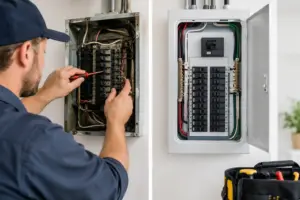
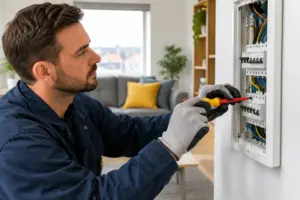
A tripping circuit, a broken fuse holder or an old board with no obvious fault can all raise the same question: is this a fuse box upgrade versus repair decision? The right answer depends on what has failed, the condition of the rest of the installation and whether the existing consumer unit can still provide suitable protection. Replacing a consumer unit is not always necessary, but neither is a repair always the sensible long-term option.
For homeowners, landlords and buyers in Bristol and Bath, the useful first step is an electrician’s assessment of the fault and the wider installation – not a guess based on the age or appearance of the board.
Fuse box upgrade versus repair: start with the condition
“Fuse box” is still the phrase most people use, although a modern installation normally has a consumer unit containing circuit breakers and RCD or RCBO protection. Older boards may use rewireable fuses or cartridge fuses. Age alone does not make a unit unsafe, but older equipment can lack the protective features expected in a modern home.
An electrician will look beyond the front cover. They will check the condition of the enclosure, terminals, protective devices, earthing and bonding arrangements, and signs of overheating. They will also test relevant circuits where required. A loose connection can cause heat damage, for example, but replacing the damaged part without finding why it loosened may only postpone the problem.
Repair is often appropriate where there is a contained fault and the consumer unit is otherwise sound. An upgrade becomes more likely where the board is obsolete, damaged, overcrowded, unsuitable for current use or unable to be brought to a satisfactory standard safely.
When a repair can be the practical option
A repair may be enough if one circuit breaker has failed, a connection has worked loose, a fuse carrier is damaged, or a single circuit is tripping because of a fault elsewhere on that circuit. The consumer unit itself may not be the source of the problem.
For instance, repeated tripping can be caused by an appliance, moisture in an outdoor fitting, a damaged cable or a fault in a socket circuit. Resetting the breaker repeatedly is not a fix. The electrician needs to identify what is causing the protective device to operate, then explain whether the remedy is within the circuit, at the board, or both.
A repair can make particular sense where the consumer unit is modern, correctly enclosed, has suitable RCD or RCBO protection and tests satisfactorily. It may be less disruptive and more proportionate than replacing equipment that is still in good condition.
That said, a repaired board should not be treated as a clean bill of health for an older installation. If testing identifies broader concerns, an Electrical Installation Condition Report (EICR) may be the appropriate next step. For landlords, the EICR is also the formal route for checking whether the installation meets the required standard for rented property.
Signs a consumer unit upgrade may be the better choice
A consumer unit replacement is usually considered as part of a wider safety and suitability decision. There are several situations where an electrician may recommend it.
An old board with rewireable fuses can be harder to maintain and may not provide the additional protection expected for many circuits today. A plastic enclosure may also need closer consideration, particularly if there are signs of heat damage or poor workmanship. Loose, burnt or corroded connections are not matters to ignore.
An upgrade may also be sensible when a property has been altered over time. Extra sockets, an extension, a converted loft, electric heating, a shower, an EV charger or solar and battery equipment can place new demands on the installation. The issue is not simply how many switches are on the board. It is whether the circuits, protection, earthing and capacity are suitable for the work now being asked of them.
A replacement can offer clearer circuit labelling, modern protective devices and capacity for planned additions. RCBOs, for example, can protect individual circuits and reduce the chance that one fault switches off large parts of the home. The exact layout should be designed around the property and its electrical installation, rather than treated as a standard swap.
Why replacing the board does not fix every electrical problem
A new consumer unit is not a cure for damaged wiring, hidden joints, faulty accessories or poor earthing. Before a replacement, the electrician needs to assess whether the existing circuits are suitable to connect to a new unit. This is one reason a like-for-like board change should never be treated as a quick cosmetic job.
During testing, older circuits can reveal faults that were not obvious before work began. Sometimes these can be repaired locally. In other cases, a circuit may need more substantial remedial work or replacement. This is not an attempt to add unnecessary work; it is the practical reality of connecting an old installation to modern protective equipment.
A good assessment sets out what has been checked, what is known, what needs further investigation and what the available options are. If the wiring is in poor condition, a consumer unit upgrade may still form part of the solution, but it should be planned alongside the necessary remedials rather than presented as the whole answer.
Safety concerns that should not wait
Some fuse box faults need prompt attention, especially if there is a burning smell, visible scorching, buzzing, sparking, repeated loss of power, water around electrical equipment or an electric shock. If it is safe to do so, switch off the affected circuit or the main switch and avoid using the installation until it has been checked. Do not remove covers or try to tighten connections yourself.
For an urgent fault, book a Rapid Response visit so an electrician can investigate the cause and make the installation safe. A rapid visit is for faults requiring attention, not a promise that every underlying repair or replacement can be completed immediately. If parts, further testing or planned work are needed, the engineer should explain the next step clearly.
Choosing the right booking route
The right service depends on what you know about the problem. If a breaker has started tripping, a socket is damaged, or there is a localised issue that appears suitable for a smaller job, Quick Fix or Quick Fix Plus may be appropriate. The electrician can diagnose the issue and advise whether a repair is possible.
If you are considering a consumer unit replacement, have been advised to upgrade after an inspection, or are planning larger electrical changes, a paid VIP onsite consultation is normally the better route. It gives the electrician the opportunity to inspect the existing installation, discuss your planned work and provide a properly informed quotation. A remote estimate may be possible where the work is suitable and you prefer not to arrange an onsite consultation, but it cannot replace checks that need to be carried out at the property.
For a landlord, homeowner or buyer who needs an overall assessment rather than a repair visit, book the relevant EICR service. An EICR records the condition of the installation at the time of inspection and identifies observations that may require remedial work. It does not automatically mean the consumer unit must be replaced, although its findings can help make that decision.
Questions worth asking before agreeing to work
You should be able to understand why repair or replacement has been recommended. Ask what fault was found, whether the existing consumer unit has passed the necessary checks, and whether the issue affects one circuit or the wider installation. If replacement is advised, ask what will be tested before the new unit is connected, what additional work might be needed if faults are found, and what certification will be provided when the job is complete.
It is also worth discussing future plans. If you expect to add an EV charger, solar PV, battery storage, an electric shower or an extension, mention it during the assessment. Allowing for realistic future requirements can be better value than fitting a unit with no practical room for later work.
MJP Electrical Services is NICEIC Approved and can assess faults, EICRs, remedial work and planned consumer unit replacements across its Bristol and Bath service areas. The aim is straightforward: establish what is wrong, make any immediate safety issue clear, and recommend repair only where it is suitable – or a replacement where that is the safer, more sensible route.
If you are unsure which applies to your home, do not rely on the age of the fuse box or a single tripped switch. Book the service that matches the urgency and let the condition of the installation guide the decision.